Leaves
Wild garlic
Allium ursinum L. · ramsons, bear's garlic, buckrams · Polish: Czosnek niedźwiedzi
Edible Partially protected
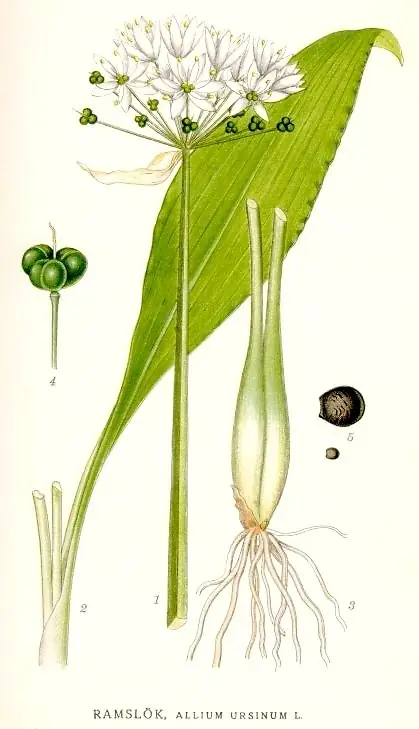
How to identify it
- Long-stalked leaves with an elliptic-lanceolate blade, long (up to 20–30 cm).
- The whole plant gives off a strong, distinctive smell of garlic — when a leaf is crushed.
- White flowers (about 2 cm across) in an umbel on a leafless, three-angled stem; flowers from April to June.
- Narrow, elongated bulb (1.5–5.5 cm).
Where it grows
The ground layer of damp broadleaved woodland, often forming extensive carpets; it does not grow on sandy or poor soils, or where water stands.
In the kitchen and the home medicine cabinet
The leaves are eaten raw or cooked: pesto, garlic butter, mixed into curd cheese (twarożek), soups and salads. The leaves are best picked before flowering (March–April). In Poland, wild-growing wild garlic must not be picked without a permit — buy leaves from cultivation or plant it in your garden.
Caution A partially protected species (regulation of 9.10.2014, Annex 2, item 218). It may be harvested only by those holding a permit from the regional/general environmental protection directorate (RDOŚ/GDOŚ), by hand, from abundant populations and only in the Silesian (śląskie), Lesser Poland (małopolskie) and Subcarpathian (podkarpackie) provinces; at least 75% of the population must be left and the underground parts must not be damaged (Annex 3). An ordinary forager therefore may not pick it in the forest. Safety: crush every leaf — no garlic smell means you must leave it; smell from a previous leaf left on your fingers can distort this test (BfR). If in doubt, do not eat it; if you have worrying symptoms after eating, call 112 or a doctor. Wild garlic is poisonous to dogs.
What not to confuse it with
Lily of the valley Deadly poisonous
Young lily of the valley leaves are easily mistaken for wild garlic; lily of the valley is poisonous in all its parts (cardiac glycosides) and does not smell of garlic.
Autumn crocus Deadly poisonous
The spring leaves of autumn crocus are sometimes gathered instead of wild garlic; autumn crocus contains colchicine and is deadly poisonous (symptoms after 6–12 hours, followed by multiple organ failure).
Frequently asked questions
When is Wild garlic in season?
In Poland, usually in March, April, May.
What can Wild garlic be confused with?
Lily of the valley: Young lily of the valley leaves are easily mistaken for wild garlic; lily of the valley is poisonous in all its parts (cardiac glycosides) and does not smell of garlic. Autumn crocus: The spring leaves of autumn crocus are sometimes gathered instead of wild garlic; autumn crocus contains colchicine and is deadly poisonous (symptoms after 6–12 hours, followed by multiple organ failure).
Is Wild garlic a protected species?
Yes, it is partially protected under the Polish regulation on the protection of plant species (rozporządzenie w sprawie ochrony gatunkowej roślin, Dz.U. 2014 poz. 1409).
Sources
- Rozporządzenie Ministra Środowiska z 9 października 2014 r. w sprawie ochrony gatunkowej roślin (Dz.U. 2014 poz. 1409)
- Lasy Państwowe: Czosnek niedźwiedzi (20.04.2023)
- Wikipedia: Czosnek niedźwiedzi
- BfR: Bärlauch – Verwechslungen führen häufig zu Vergiftungen (04.04.2023)
- BfR: Geruchstest mit Tücken – worauf beim Bärlauch-Sammeln geachtet werden sollte (21.03.2025)
- pacjent.gov.pl: Co robić w przypadku zatrucia (20.04.2022)
Last checked: 9 November 2026. Spotted a mistake? Write to us.