
Comparison
Cornflower bolete or devil's bolete? How to tell them apart
Cornflower bolete is an edible mushroom, while the devil's bolete is a poisonous mushroom. Compare the two mushrooms point by point.
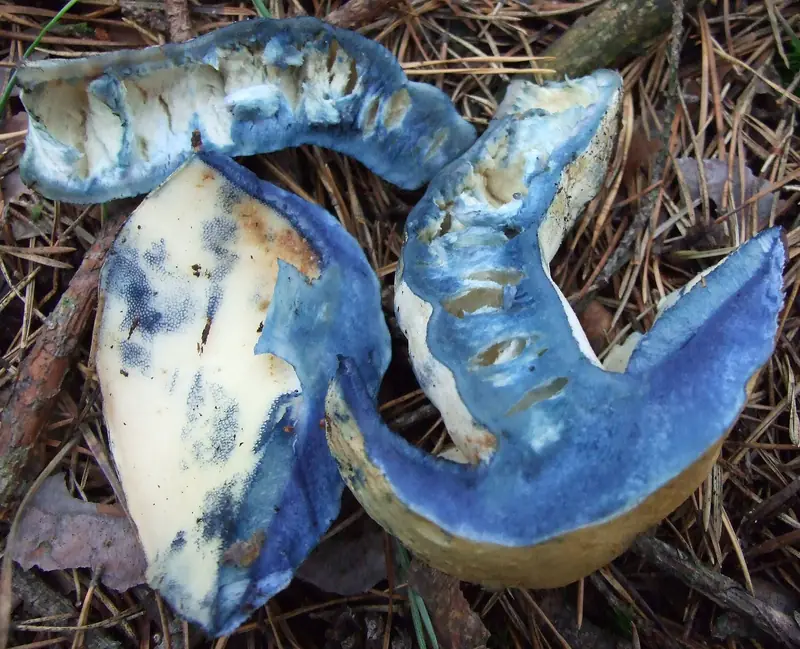
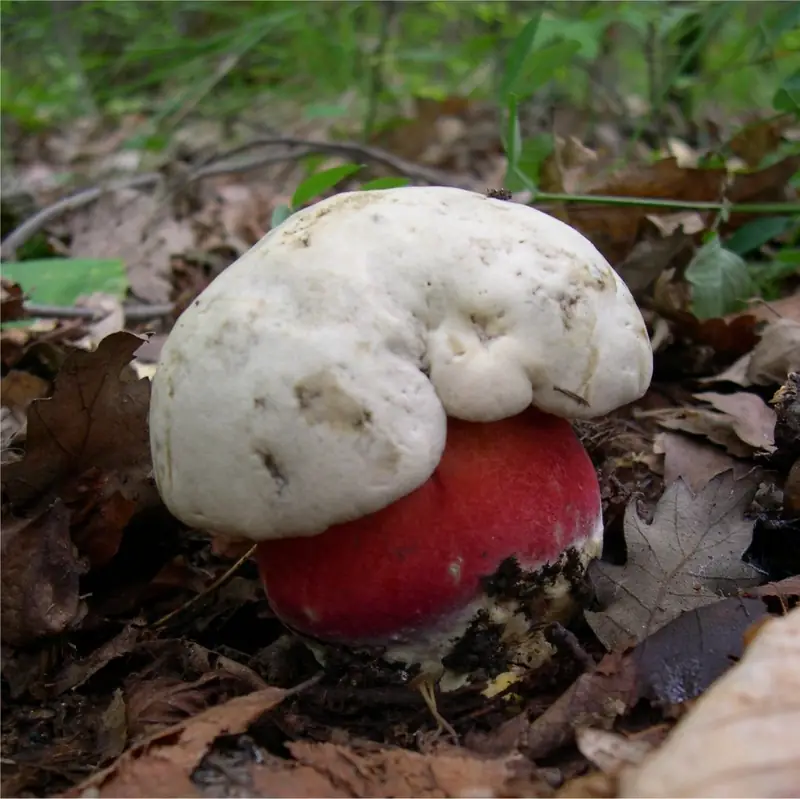
Other bluing boletes (e.g. the poisonous devil's bolete) have red pores and a solid stem; the cornflower bolete has white pores and a chambered stem. Not in this atlas: Gyroporus castaneus (chestnut bolete; rusty-brown cap, flesh does not turn blue) – also edible.
Feature by feature
| Feature | Cornflower bolete | Devil's bolete |
|---|---|---|
| Edibility | Edible | Poisonous |
| Cap | 3.5–12 cm across, straw-yellow, cream to yellow-brown; surface dry, matt, felty-tufted; turns blue when pressed. | Large, 10–25(30) cm, light grey, silvery grey or whitish with olive patches, pinkish at the margin with age; surface smooth or finely suede-like. |
| Under the cap | Tubes and pores white, then cream, turn blue when touched; spore print pale yellow. | Tubes yellowish, turn blue when damaged; pores orange-yellow in young specimens, then blood-red to carmine-red, olive in old ones. |
| Stem | Same colour as the cap, brittle, chambered inside (with hollow cavities); turns intensely blue when pressed. | Strongly bulbous, yellow at the top, carmine-red lower down, with a yellowish to reddish network in the upper part. |
| Flesh | White or yellowish, turns intensely cornflower-blue immediately when cut. | Whitish to pale yellow, turns slowly and slightly blue when cut. |
| Smell and taste | Smell and taste indistinct. | Taste mild; old fruit bodies have an unpleasant smell reminiscent of carrion. |
| Habitat | Only sandy soils: pine forests in the lowlands, less often broadleaf and mixed forests, e.g. mountain beech woods. | Warm, open broadleaf forests (beech and oak woods) on calcareous soils; only a few sites are known in Poland (Sudetes, Kraków-Częstochowa Upland, Ponidzie). |
| Season | July, August, September, October, November | July, August, September |
How to recognise it: cornflower bolete
- Flesh turns cornflower-blue instantly
- Stem brittle, chambered inside
- Pale, felty cap
- Only on sand
How to recognise it: devil's bolete
- Light grey, chalk-white cap
- Red pores
- Bulbous stem, carmine below, with a reddish network
- Only on limestone, very rare
Safety rule
Never eat a mushroom identified only from a website, a photo or an app. Show any doubtful specimen to a certified mushroom inspector at the sanepid (state sanitary inspection); in season the advice points are free. Do not give wild-picked mushrooms to children.
The golden rules of foraging →Frequently asked questions
Cornflower bolete or devil's bolete: how can you tell them apart?
Other bluing boletes (e.g. the poisonous devil's bolete) have red pores and a solid stem; the cornflower bolete has white pores and a chambered stem. Not in this atlas: Gyroporus castaneus (chestnut bolete; rusty-brown cap, flesh does not turn blue) – also edible.
Devil's bolete: what to do if you have eaten it?
Call 112 at once or go to A&E (SOR), and take any leftover mushrooms with you. Gastrointestinal syndrome (vomiting, diarrhoea, abdominal pain). Toxicity is attributed to the glycoprotein bolesatine; muscarine is present in amounts presumably too small to explain the poisoning. Most potent when raw or undercooked.
Sources
- Wikipedia (pl): Piaskowiec modrzak
- Atlas grzybów Polski – grzyby.pl (M. Snowarski)
- First Nature – fungi
- Wikipedia (pl): Krwistoborowik szatański
- Atlas grzybów Polski – grzyby.pl (M. Snowarski)
- First Nature – fungi
Last checked: 9 November 2026. Spotted a mistake? Write to us.