Boletes (pores under the cap)
Chicken of the woods
Laetiporus sulphureus · also known as: Sulphur shelf, Sulphur polypore
Edible with careApproved for sale
Only young, juicy fruit bodies (or their edges) are edible after preparation: rinsing, parboiling and discarding the water. Poisonous raw, old fruit bodies inedible. Do not pick from yews (suspected uptake of toxins – unproven according to Wikipedia, First Nature warns). A small proportion of people tolerate it poorly.
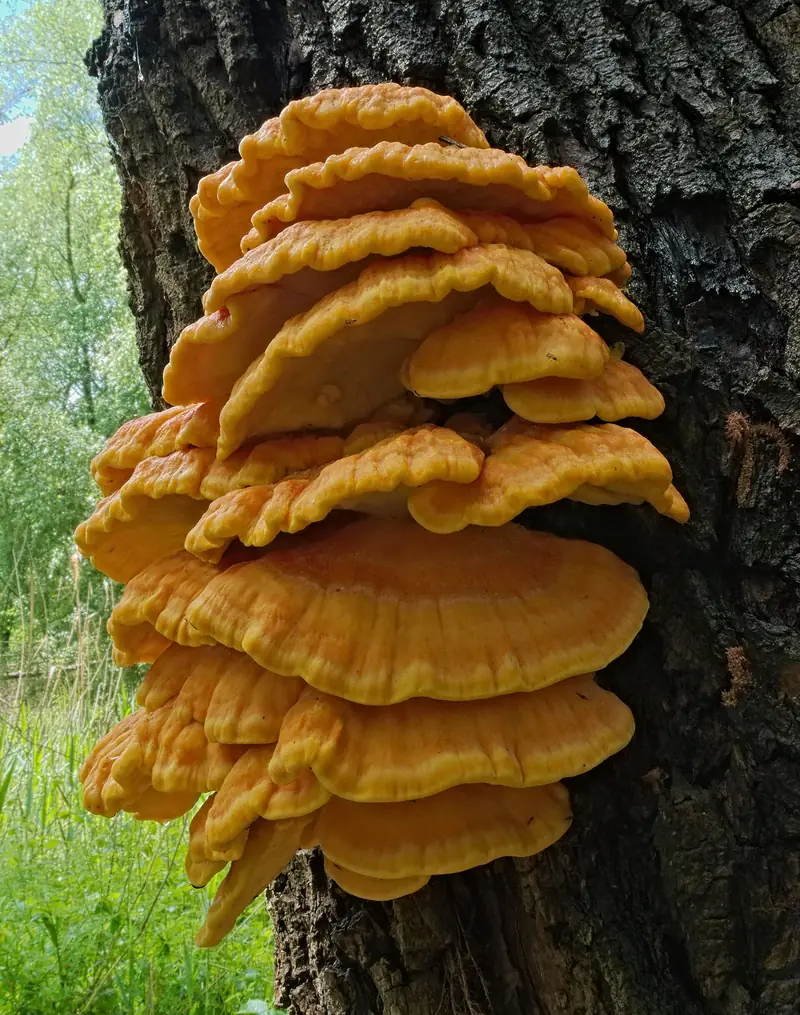
How to recognise it: chicken of the woods
- 1
Bright yellow-orange “shelves” on trunks of broadleaf trees
- 2
Fine yellow pores underneath
- 3
Most often in spring and early summer
- 4
Young – soft and juicy, old – brittle and pale
Description
- Cap
- Fruit body without a stem, attached at the side; fan-shaped brackets 10–40 (50) cm, in tiers one above another; bright sulphur-yellow to orange (apricot), fading to greyish-white with age.
- Tubes and pores
- Tubes short, pores very fine (3–5 per mm), sulphur-yellow.
- Stem
- No stem (the fruit body is attached to the wood at the side).
- Flesh
- Soft, juicy, cream-yellow in young specimens; with age brittle, white, cheese-like; does not change colour.
- Smell and taste
- Taste sourish, bitter with age; smell mushroomy, sometimes unpleasant in fresh specimens. Spore print white to pale yellow.
Where and when it grows
A parasite of living (less often dead) broadleaf trees: oak, willow, poplar, black locust, birch, fruit trees; more often along roads, in parks, orchards and gardens than in forests. Peak fruiting in spring and early summer (May–June).
Most often with: oak, willow, poplar, black locust, birch, wild cherry
Foragers’ finds
All photosPhotos and identifications are added by users; we do not check them. Add your own find →
In the kitchen
Only young fruit bodies: rinse, parboil, discard the water, then e.g. fry in breaded slices. Do not pick from yews.
Watch out for toxins
Raw it causes gastrointestinal illness; in sensitive people reactions also after cooking.
Protection and sale
- Species protection: the species is not protected.
- Sale: the species is on the list of mushrooms approved for sale (it may be sold only with a mushroom inspector’s certificate).
Chicken of the woods: common questions
Is the chicken of the woods edible?
Edible with care. Only young, juicy fruit bodies (or their edges) are edible after preparation: rinsing, parboiling and discarding the water. Poisonous raw, old fruit bodies inedible. Do not pick from yews (suspected uptake of toxins – unproven according to Wikipedia, First Nature warns). A small proportion of people tolerate it poorly.
When does the chicken of the woods grow?
In Poland the fruiting bodies usually appear in: April, May, June, July, August, September, October. Habitat: A parasite of living (less often dead) broadleaf trees: oak, willow, poplar, black locust, birch, fruit trees; more often along roads, in parks, orchards and gardens than in forests. Peak fruiting in spring and early summer (May–June).
Sources
- Wikipedia (pl): Żółciak siarkowy
- grzyby.pl (atlas M. Snowarskiego): Laetiporus sulphureus
- First Nature: Laetiporus sulphureus
- Rozporządzenie Ministra Zdrowia w sprawie grzybów dopuszczonych do obrotu… – tekst jednolity Dz.U. 2026 poz. 258
Last checked: 9 November 2026. Spotted a mistake? Write to us.