Boletes (pores under the cap)
Bovine bolete
Suillus bovinus · also known as: Jersey cow mushroom
EdibleApproved for sale
Edible, of moderate value – rubbery, elastic flesh. After cooking and drying it turns red-violet, which is normal.
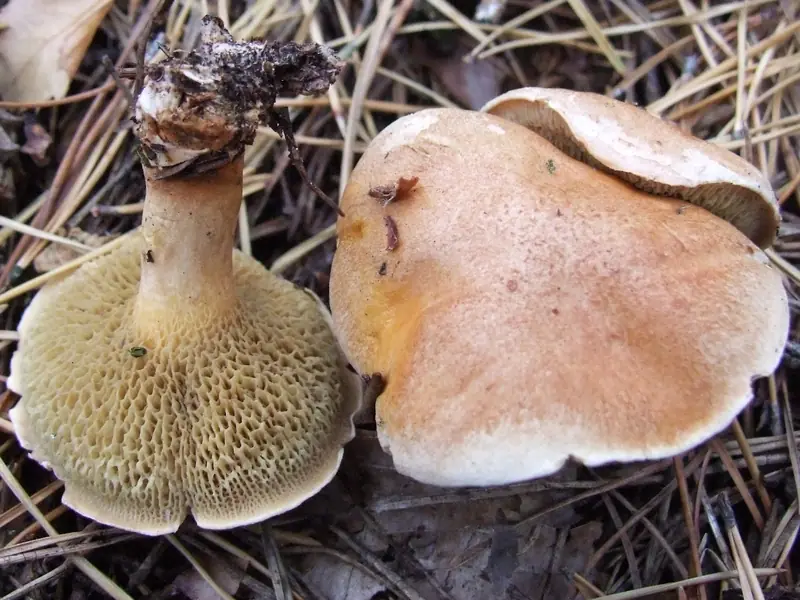
How to recognise it: bovine bolete
- 1
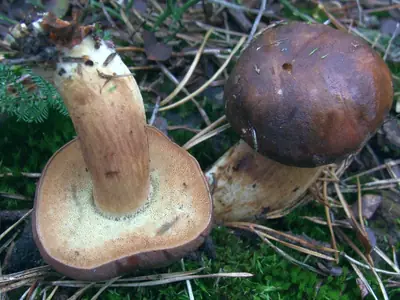
Large, angular pores “like a sieve”
- 2
Rubbery, elastic fruit body
- 3
No ring
- 4
Grows in masses under pine on sand
Description
- Cap
- 3–12 cm across, buff, orange-brown or pale flesh-coloured, often with a paler margin; sticky, rubbery and elastic to the touch.
- Tubes and pores
- Tubes decurrent, yellow to grey-ochre; pores very large, angular, compound (like the mesh of a sieve).
- Stem
- Same colour as the cap, cylindrical, without a ring; mycelium at the base whitish to pink.
- Flesh
- Whitish, yellowish to brownish, very elastic; turns slightly blue, pinkish-red when dried.
- Smell and taste
- Smell and taste faint, slightly fruity or sourish.
Where and when it grows
Dry, poor sandy soils under pine, often among heather and at forest edges; usually in masses, in clusters.
Most often with: pine
Look-alikes: what it can be mistaken for
Velvet bolete Edible low risk
The velvet bolete has finer pores, a felty (not sticky) cap and firm flesh. Edible. Not in this atlas: Gyrodon lividus (alder bolete; under alders, tubes strongly decurrent).
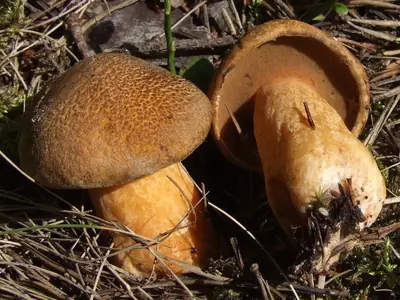
Foragers’ finds
All photosPhotos and identifications are added by users; we do not check them. Add your own find →
In the kitchen
Drying and pickling, best mixed with other mushrooms; turns copper-red when pickled.
Protection and sale
- Species protection: the species is not protected.
- Sale: the species is on the list of mushrooms approved for sale (it may be sold only with a mushroom inspector’s certificate).
Bovine bolete: common questions
Is the bovine bolete edible?
Edible. Edible, of moderate value – rubbery, elastic flesh. After cooking and drying it turns red-violet, which is normal.
When does the bovine bolete grow?
In Poland the fruiting bodies usually appear in: June, July, August, September, October. Habitat: Dry, poor sandy soils under pine, often among heather and at forest edges; usually in masses, in clusters.
What can the bovine bolete be mistaken for?
Velvet bolete (edible): The velvet bolete has finer pores, a felty (not sticky) cap and firm flesh. Edible. Not in this atlas: Gyrodon lividus (alder bolete; under alders, tubes strongly decurrent).
Sources
Last checked: 9 November 2026. Spotted a mistake? Write to us.