Gilled mushrooms
Fishy milkcap
Lactifluus volemus · also known as: Weeping milk cap, Voluminous-latex milky, Tawny milkcap
EdibleApproved for sale
Edible, considered excellent by some. Polish sources state that it is sometimes even eaten raw with salt (an exception among mushrooms), but it is safer to eat it after cooking. Isolated cases of transient pancreatitis after eating it have been described (Turkey). Since 2021 the Polish Mycological Society (PTMyk) committee has recommended the name “mleczajowiec smaczny”.
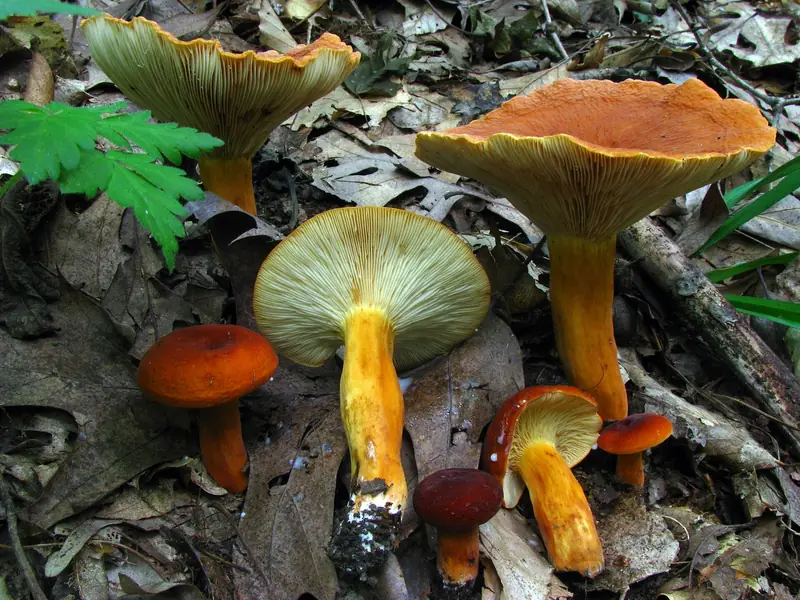
How to recognise it: fishy milkcap
- 1
Very abundant white, MILD (not burning) milk
- 2
Smell of herring
- 3
Uniformly russet-orange, matt cap without bands
- 4
Gills turn brown when damaged
Description
- Cap
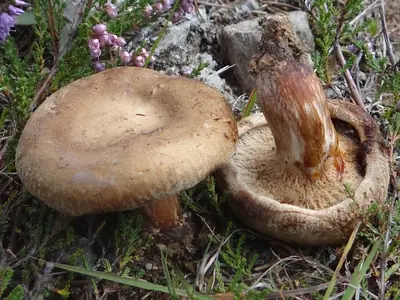
- 5–15 cm, uniformly russet-orange to orange-brown, without bands; matt, velvety, often finely cracked; margin long inrolled.
- Gills
- Gills whitish, pale yellow with age, crowded, adnate to decurrent; turn brown (rust) when damaged.
- Stem
- 6–12 cm, clearly paler than the cap, orange-yellowish, smooth, solid.
- Flesh
- Whitish, firm. At the slightest injury exudes very abundant, thick, WHITE milk which slowly turns brown in the air.
- Smell and taste
- A characteristic strong smell of herring (fishy), especially in older or drying fruit bodies; taste and milk mild, with a bitterish aftertaste.
Where and when it grows
Broadleaf forests (under beech, oak, hornbeam, hazel, aspen), less often coniferous; prefers clay soils, alkaline to slightly acidic. Grows singly or in small groups.
Most often with: beech, oak, hornbeam, hazel, aspen, spruce, pine
Foragers’ finds
All photosPhotos and identifications are added by users; we do not check them. Add your own find →
In the kitchen
Fried over medium heat (e.g. in butter with caraway), do not overcook until dry; avoid damaging it when picking, because it loses the milk that gives it its flavour. The herring smell disappears during cooking.
Protection and sale
- Species protection: the species is not protected.
- Sale: the species is on the list of mushrooms approved for sale (it may be sold only with a mushroom inspector’s certificate). Listed in Annex 1 as “mleczaj smaczny – Lactarius volemus”.
Fishy milkcap: common questions
Is the fishy milkcap edible?
Edible. Edible, considered excellent by some. Polish sources state that it is sometimes even eaten raw with salt (an exception among mushrooms), but it is safer to eat it after cooking. Isolated cases of transient pancreatitis after eating it have been described (Turkey). Since 2021 the Polish Mycological Society (PTMyk) committee has recommended the name “mleczajowiec smaczny”.
When does the fishy milkcap grow?
In Poland the fruiting bodies usually appear in: June, July, August, September, October. Habitat: Broadleaf forests (under beech, oak, hornbeam, hazel, aspen), less often coniferous; prefers clay soils, alkaline to slightly acidic. Grows singly or in small groups.
Sources
- Mleczajowiec smaczny – Wikipedia (PL)
- Lactarius volemus – Atlas grzybów Polski (grzyby.pl, M. Snowarski)
- Lactifluus volemus – Wikipedia (EN)
- Rozporządzenie Ministra Zdrowia w sprawie grzybów dopuszczonych do obrotu… – tekst jednolity Dz.U. 2026 poz. 258 (załącznik nr 1)
Last checked: 9 November 2026. Spotted a mistake? Write to us.