Fruit
Elderberries
Sambucus nigra L. · elder, black elder, European elder · Polish: Bez czarny (owoce)
Edible with care
How to identify it
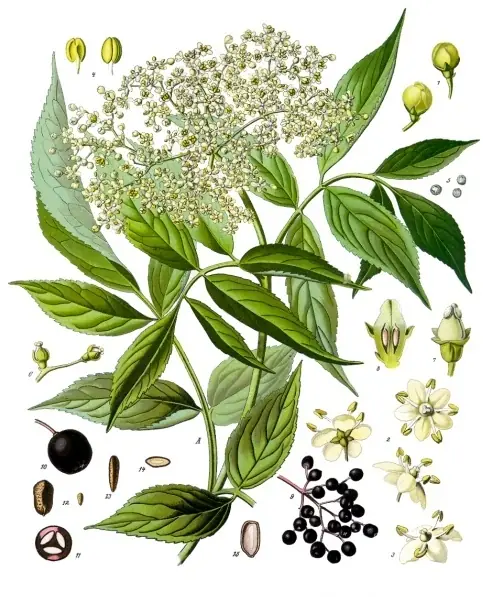
- Fruit: small drupes, purple-black when ripe, in large, drooping flat-topped clusters; each contains 3–6 seeds.
- Pith of the shoots white (in red-berried elder it is cinnamon-coloured).
- The berries ripen from late August to October.
Where it grows
Woodland and scrub, in the mountains up to the lower montane forest belt; prefers fertile soils rich in nitrogen and phosphorus.
In the kitchen and the home medicine cabinet
Pick only ripe, black berries (best in September), with no green berries and as few stalks as possible. The berries must be heat-treated: juice, syrup, preserves, jams, kissel (thickened fruit dessert), wine, nalewka (fruit liqueur).
Caution Raw and unripe berries, leaves, bark and seeds contain sambunigrin (a cyanogenic glycoside). Eating raw or unripe berries can cause nausea, vomiting and diarrhoea; 11 people fell ill after drinking juice made from raw berries, leaves and twigs. Cooking removes the poisonous properties (hydrogen cyanide is volatile), so always process elderberries before eating. A 2021 review notes that cooking is only partly effective — all the more reason to discard green berries and stalks.
What not to confuse it with
Red-berried elder Poisonous
Red-berried elder has coral-red berries in rounded panicles and ripens earlier; its berries are poisonous raw.
Frequently asked questions
When is Elderberries in season?
In Poland, usually in August, September, October.
What can Elderberries be confused with?
Red-berried elder: Red-berried elder has coral-red berries in rounded panicles and ripens earlier; its berries are poisonous raw.
Sources
- Lasy Państwowe: Czas na syrop z owoców bzu czarnego (30.08.2022)
- EMA/HMPC: Assessment report on Sambucus nigra L., fructus (EMA/HMPC/44208/2012)
- Nadleśnictwo Strzebielino (Lasy Państwowe): Bez czarny i koralowy (13.10.2017)
- Wikipedia: Bez czarny
- Appenteng et al., Molecules 2021 – cyanogenic glycosides in elderberry
Last checked: 9 November 2026. Spotted a mistake? Write to us.