Gilled mushrooms
Oyster mushroom
Pleurotus ostreatus · also known as: Pearl oyster mushroom
EdibleApproved for sale
A tasty edible mushroom, cultivated on a large scale (available in shops). In the wild it can be confused mainly with the late oyster (Sarcomyxa/Panellus serotinus – smaller, greenish, yellow stem, gills not deeply decurrent) and other oyster mushrooms. Inhaling large amounts of spores (e.g. in growing facilities) can harm the lungs.
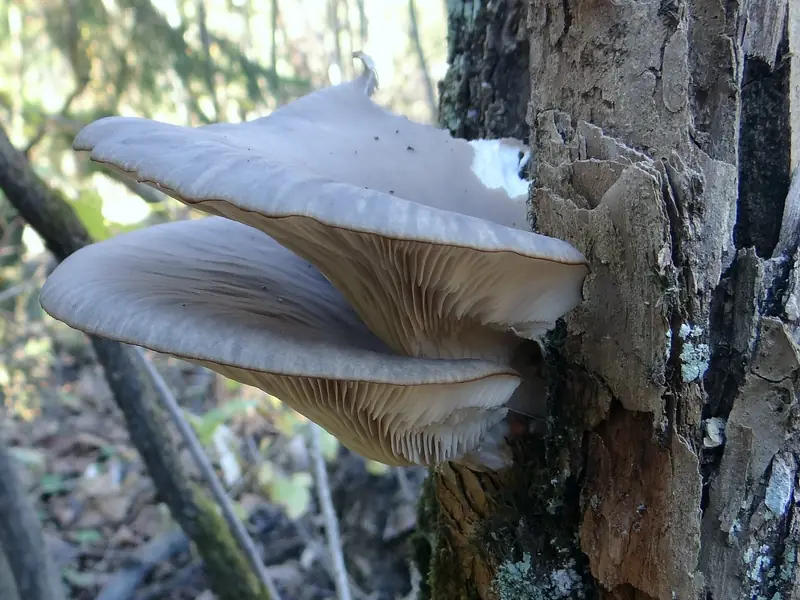
How to recognise it: oyster mushroom
- 1
Tiered clusters on broadleaf wood in late autumn and winter
- 2
Shell-shaped cap attached at the side
- 3
White gills running deeply down a short stem
- 4
White spore print
Description
- Cap
- 5–15 (25) cm, shell- or fan-shaped, attached at the side; colour very variable – grey, grey-brown, steel-blue, violet-brown; smooth, not sticky.
- Gills
- Gills crowded, whitish to greyish, deeply decurrent down the stem.
- Stem
- Short (1–4 cm) or almost absent, lateral, white, with white bristles at the base; stems of fruit bodies in a cluster fused together.
- Flesh
- White, soft in young specimens, elastic in older ones, fibrous in the stem; does not change colour.
- Smell and taste
- Taste mild, slightly sourish, smell pleasant. Spore print white.
Where and when it grows
On dead and weakened wood of broadleaf trees (beech, willow, poplar, birch, hornbeam, black locust), very rarely on spruce; fruit bodies in tiers one above another, in late autumn after the first frosts, in mild winters and early spring.
Most often with: beech, willow, poplar, birch, hornbeam, black locust, walnut
Foragers’ finds
All photosPhotos and identifications are added by users; we do not check them. Add your own find →
In the kitchen
Frying, stewing, soups and mushroom mixes; young, soft fruit bodies are best (discard tough stems).
Protection and sale
- Species protection: the species is not protected. The king oyster (Pleurotus eryngii) from wild sites is strictly protected – it is a different species, growing on field eryngo, not on wood.
- Sale: the species is on the list of mushrooms approved for sale (it may be sold only with a mushroom inspector’s certificate).
Oyster mushroom: common questions
Is the oyster mushroom edible?
Edible. A tasty edible mushroom, cultivated on a large scale (available in shops). In the wild it can be confused mainly with the late oyster (Sarcomyxa/Panellus serotinus – smaller, greenish, yellow stem, gills not deeply decurrent) and other oyster mushrooms. Inhaling large amounts of spores (e.g. in growing facilities) can harm the lungs.
When does the oyster mushroom grow?
In Poland the fruiting bodies usually appear in: October, November, December, January, February, March. Habitat: On dead and weakened wood of broadleaf trees (beech, willow, poplar, birch, hornbeam, black locust), very rarely on spruce; fruit bodies in tiers one above another, in late autumn after the first frosts, in mild winters and early spring.
Sources
- Wikipedia (pl): Boczniak ostrygowaty
- grzyby.pl (atlas M. Snowarskiego): Pleurotus ostreatus
- First Nature: Pleurotus ostreatus
- Rozporządzenie Ministra Zdrowia w sprawie grzybów dopuszczonych do obrotu… – tekst jednolity Dz.U. 2026 poz. 258
Last checked: 9 November 2026. Spotted a mistake? Write to us.