Gilled mushrooms
Shaggy parasol
Chlorophyllum rhacodes
Poisonous
Sources disagree: Polish guides (Wikipedia, grzyby.pl) list it as edible but not very tasty, with the caveat that in sensitive people it causes gastrointestinal illness, and advise against picking it because of its similarity to poisonous species; First Nature states that it poisons a large proportion of people, sometimes seriously. We cautiously classify it as poisonous. Similar species: Chlorophyllum brunneum (garden shaggy parasol) and Ch. venenatum are poisonous, and Ch. molybdites (green-spored parasol) is beginning to spread in Europe.
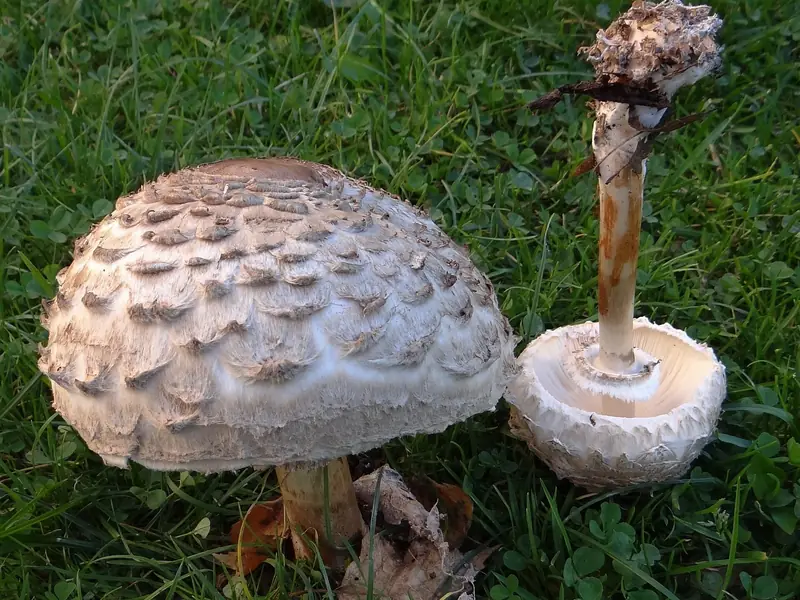
How to recognise it: shaggy parasol
- 1
Flesh turns red when cut, then brown
- 2
Stem smooth, without the parasol's snakeskin pattern
- 3
Coarse, raised scales on the cap
- 4
Distinct bulb at the stem base and a movable ring
Description
- Cap
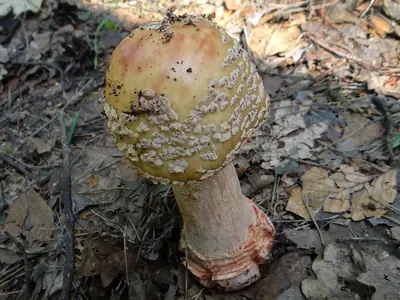
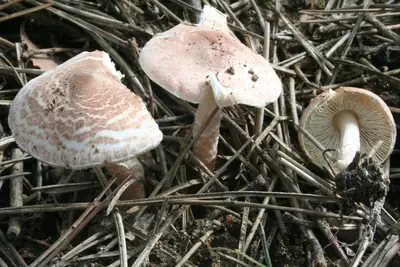
- 8–15 cm, globose when young, then convex to parasol-shaped, usually without a distinct umbo; grey-brown, covered with coarse, overlapping (shingled), raised, woolly scales, the centre smooth.
- Gills
- Gills white, crowded, free; turn red when pressed, brownish with age.
- Stem
- Up to 15 cm, smooth, whitish to brown, without a zigzag pattern; a distinct bulb at the base; ring double, thick, movable. The base quickly turns brownish-red when rubbed.
- Flesh
- White; when cut first yellow-orange, then brownish-red, especially in the stem.
- Smell and taste
- Smell indistinct or faint (without the sweetish aroma of the parasol); taste mild.
Where and when it grows
Saprotrophic; coniferous forests (under pine and spruce), mixed and broadleaf forests, forest glades, forest edges, parks, scrub.
Look-alikes: what it can be mistaken for
Parasol mushroom Edible medium risk
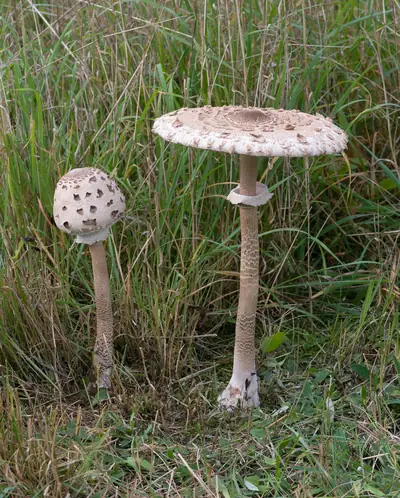
The parasol has a zigzag pattern on the stem, flesh that does not change colour when cut, finer, flattened scales and a distinct sweetish-nutty smell. The mistake the other way round (shaggy parasol instead of parasol) happens very often.
Step-by-step comparison: Parasol mushroom or shaggy parasol →
Foragers’ finds
All photosPhotos and identifications are added by users; we do not check them. Add your own find →
Protection and sale
- Species protection: the species is not protected.
- Sale: the species is not on the list of mushrooms approved for sale. Not on the list of mushrooms permitted for sale.
Shaggy parasol: common questions
Is the shaggy parasol edible?
Poisonous. Sources disagree: Polish guides (Wikipedia, grzyby.pl) list it as edible but not very tasty, with the caveat that in sensitive people it causes gastrointestinal illness, and advise against picking it because of its similarity to poisonous species; First Nature states that it poisons a large proportion of people, sometimes seriously. We cautiously classify it as poisonous. Similar species: Chlorophyllum brunneum (garden shaggy parasol) and Ch. venenatum are poisonous, and Ch. molybdites (green-spored parasol) is beginning to spread in Europe.
When does the shaggy parasol grow?
In Poland the fruiting bodies usually appear in: July, August, September, October. Habitat: Saprotrophic; coniferous forests (under pine and spruce), mixed and broadleaf forests, forest glades, forest edges, parks, scrub.
What can the shaggy parasol be mistaken for?
Parasol mushroom (edible): The parasol has a zigzag pattern on the stem, flesh that does not change colour when cut, finer, flattened scales and a distinct sweetish-nutty smell. The mistake the other way round (shaggy parasol instead of parasol) happens very often.
Sources
- Wikipedia (pl): Czubajnik czerwieniejący
- grzyby.pl (M. Snowarski): Chlorophyllum rhacodes
- First Nature: Chlorophyllum rhacodes, Shaggy Parasol
Last checked: 9 November 2026. Spotted a mistake? Write to us.